
I built a copy of myself in Obsidian.
For many years, I’ve tried every system for managing information and processes. CRMs, project tools, wikis, SOPs, every note-taker that’s had a launch post.
Then I started building an AI-connected second brain in Obsidian, and the way I work changed completely.
Now when I log in for work, I have a co-pilot that’s basically a clone of me. For someone who’s a bit of a perfectionist (wink, wink), it’s a magnificent way to enhance myself: a working copy of me, one that holds all the important information and remembers it way better than I do.
Why context is everything
The thing that makes or breaks an AI co-pilot isn’t prompting. It’s context. Who you are, what you know, how you work, what you’ve decided and why. Without that, you’re talking to a stranger every time. With it, the LLM can act like a co-worker who actually knows the account.
Andrej Karpathy popularized this approach earlier this year: a plain Markdown folder as the context layer, instead of the heavier setup the industry calls RAG. For anything less than enterprise scale, the trade is a no-brainer. The agent reads the actual file, not a fuzzy chunk-match.
Setup is having a folder.
So what does this look like in practice?
Every meeting transcript. Every SOP. Old project notes, audit notes from a year ago, decision pages from six months back. All of it sits in one place that the agent reads before I do. I’m not searching anymore, the agent is. It pulls relevant bits faster and better than I ever could, so my decisions are better informed by my own past thinking.
And I don’t work alone anymore. There’s always someone I can talk to, who is never sick, and who gets better over time.
What it actually is
It’s an Obsidian vault. Plain Markdown files in a folder on my computer. The rest is what makes it useful:
-
The files stay on my computer. They’re app-agnostic, meaning the knowledge isn’t trapped in someone’s proprietary database, no matter which app I open them with.
-
It’s not locked to any one LLM, either. Steph Ango, the Obsidian CEO, has a phrase for this: file over app. Your files should outlive any tool you use to read them. I switch between LLMs pretty often, and the context is what you want to bring with you. Having the second brain on my own machine means I can connect to a different LLM in minutes.
I keep the structure simple. Four folders at the top: projects, entities, concepts, decisions. Projects are current work. Entities are clients and vendors. Concepts are patterns I want to remember. Decisions are why I chose X over Y on a specific account, on a specific date.
That’s the whole structure. Nothing fancier.
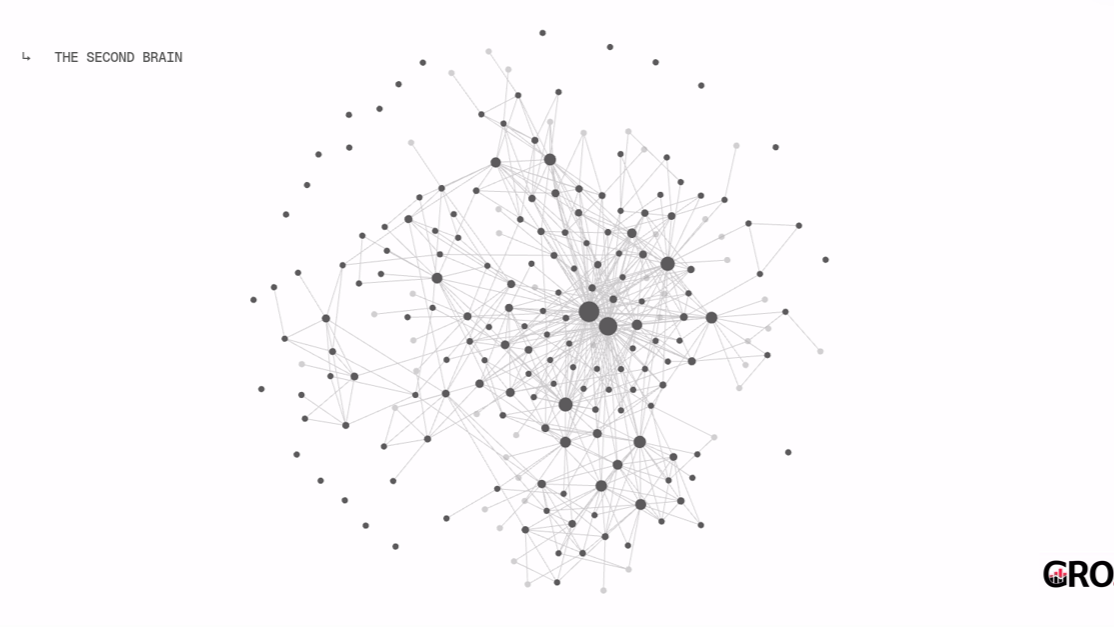
There’s also a graph view (screenshot below). It shows the connections between the notes, and I like to watch it grow. It starts looking like an actual brain.
How it improves over time
Because it does improve, the way a child’s brain grows. One new fact, one new pattern, one new exception at a time, until the layer of context underneath gets thick enough that you stop noticing it’s there.
The agent gathers context on its own. It reads my email, my meeting transcripts, my chat apps, WhatsApp, Slack, what have you. Every day, the vault grows.
One of the most important things sitting in there is my Google Ads management principles, a rolling document I keep adding to, distilled from twenty years of work. Many of them go against what Google’s UI recommends. The agent reads it before every audit, every restructure plan, every recommendation it drafts on a client account. Every new principle I add applies across every client, without me having to remind anyone.
I’ve got everything in there now. Which, honestly, is a little scary, because I’m basically condensing twenty-plus years into one vault and handing Claude the keys. It’s also been very helpful.
What it doesn’t do
It doesn’t make the decisions for me. The thinking is enhanced now. The agent thinks with me, and sometimes for me. The decisions and the steering of them are mine.
It doesn’t compound out of thin air, either. Every source the agent pulls from is a connection I had to wire in: my email, my meeting transcripts, my chat apps, the vault itself. Most of them took weeks. Obsidian doesn’t do the wiring. You do.
Once it’s wired in, the payoff shows up fast. I felt it within hours, not months. From there, the work is curation: deciding what gets captured, what gets thrown away, where it lives, when to update it. The system itself improves as you go.
It also doesn’t read the vault on its own without being asked. Before, I had to tell it “don’t forget to read the second brain for this topic.” Lately I’ve hooked that up so I don’t have to.
It’s not magic. It’s a folder of Markdown files, and an agent that knows how to read and write to it.
So, yeah. It’s been a ride, and it’s been a trip, and I wish for you to experience some version of this yourself.
Twenty years in, I finally have a co-worker who understands me better than anyone, and goes as hard as I am. And it’s slowly getting better at being me than I am, for the parts of me that forget.
If you’d like to see how a specific piece of it works (the plumbing, the rules, the way it grows), I’ll write the next one on that.