We inherited the Google Ads account of a premium executive-education institute running programmes in Germany — a school whose participant roster reads like an enterprise client list, with names like Microsoft on the books. The advertising told a different story. Around €80 per enquiry, fourteen enquiries a month, and no conversion-tracking discipline underneath holding it together. Six months later the cost per enquiry was down to €30 and the monthly volume had more than doubled. The work in between was less about bidding strategy than about giving the campaign something honest to optimise against.
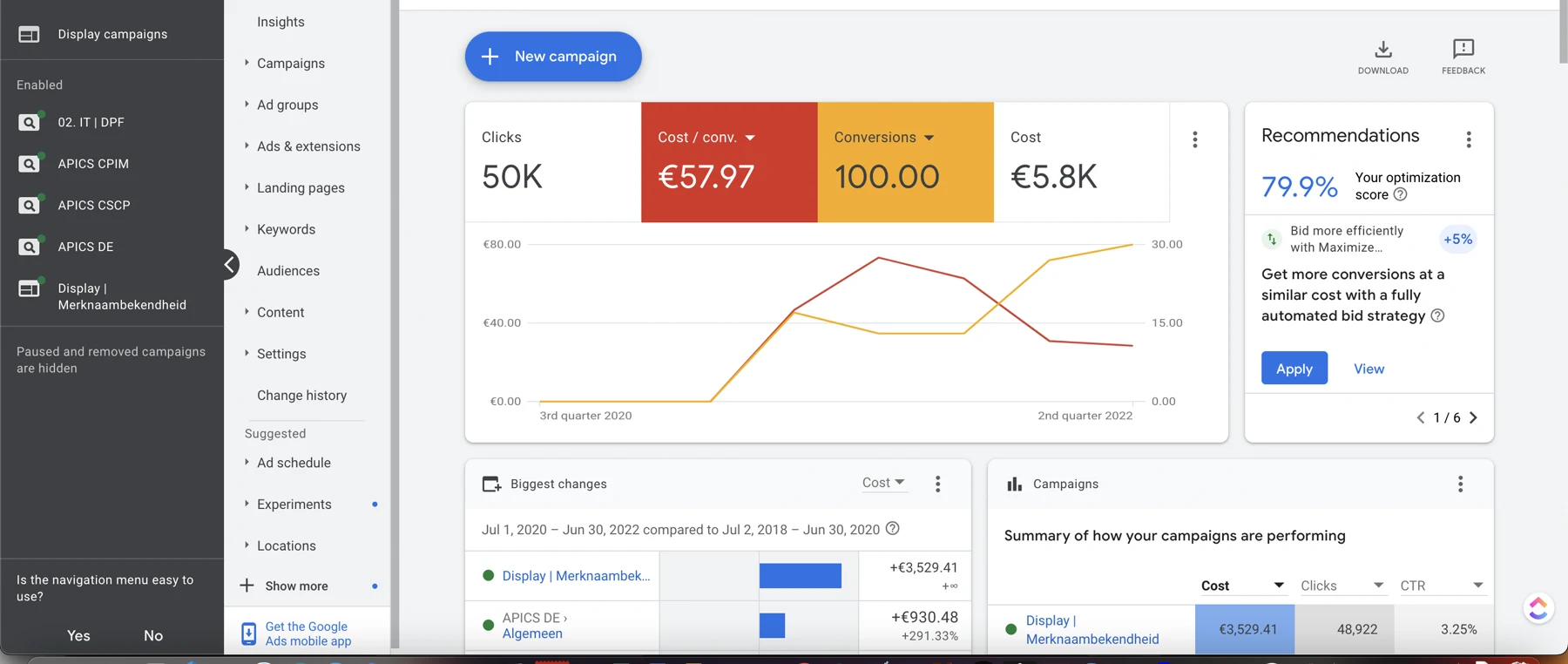
This screenshot deliberately covers a wider window than the engagement itself — the inflection visible in the chart is the 6-month rebuild, not the blended average. Read the curve: the yellow cost-per-conversion line descends from a high inherited baseline through 2021, while red conversion volume climbs as the tracking rebuild and intent-mapped Search structure compound. The engagement-end numbers cited below (€30 CPL, 30 enquiries / month) describe the post-rebuild state — not the 24-month blend.
Fix the signal first, then let the algorithm do its job
An executive-education programme that lists enterprise clients on its participant page does not need lead-volume hacks. It needs a campaign that can recognise a high-intent decision-maker when one arrives, and stop bidding when one doesn’t. The inherited account couldn’t tell the difference. Conversion definitions were thin, the import into Google Ads was loose, and the €80 CPL the dashboard reported wasn’t measuring the enquiries that actually mattered to the admissions team.
The first question wasn't a bidding question. It was a measurement question: which on-site actions count as a real programme enquiry, and is the campaign being told about them correctly?
We rebuilt the conversion-tracking layer from the ground up. Programme-enquiry form submits, brochure-download events, scheduled-consultation requests — each one mapped to a specific Google Ads conversion action, with the irrelevant page-view and scroll noise stripped out of the import. Once the bidding algorithm could see which clicks led to actual enquiries instead of vague engagement, the auction-side maths shifted on its own.
Tracking discipline determines which clicks get bid up and which get bid down. Fix the signal and the algorithm stops paying €80 for clicks that never produced an enquiry the admissions team wanted to follow up on.
With tracking honest, the campaign structure followed. Search clusters separated by the kind of decision-maker behind the query — individual executives researching specific programme tracks, HR and L&D teams sourcing for corporate cohorts, generic executive-education demand each kept distinct. Budget moved off the broad-match catch-alls that had been spending without converting and onto the keyword themes where enquiries were actually landing.
By month six, the same monthly budget envelope was producing roughly thirty enquiries at around €30 each — twice the volume at less than half the cost, all of it defensible against an honest tracking layer the admissions team trusted.
Six months, twice the enquiries, sixty-plus percent off the cost per lead
Pre-engagement: roughly fourteen monthly enquiries at around €80 each. Post-engagement: roughly thirty monthly enquiries at around €30 each. The volume more than doubled and the cost per enquiry dropped by over 60%, on a budget envelope that didn’t materially change. The shift came from rebuilding what the campaign was being asked to measure, then redirecting the existing spend toward what that signal was pointing at.
Cost per enquiry, before and after.
Boring, predictable, attributable. That’s what good PPC looks like.
Every engagement starts with a 30-minute audit — free, no slides, just a screen-share through your account.
Book the audit →