
Ads inside Google's AI answers: live in Australia, New Zealand and Singapore, not in Europe.
On 5 November 2026 I read Google’s help page on ads in AI Overviews and AI Mode.
These are the questions I think matter most. By “AI answers” I mean AI Overviews and AI Mode together.
The short version:
↳ Advertisers in Australia, New Zealand and Singapore can already show inside AI answers. In Europe, including the UK, Google only confirms ads above or below an AI Overview.
What’s the difference between AI Overviews and AI Mode?
AI Overviews is the AI-written summary inside the normal results page. There is no off switch. The only way to hide it is the ‘Web’ filter.
AI Mode is a separate mode you choose yourself. It works like a conversation, with follow-up questions.
Both are available across Europe, the UK included. And in Australia, New Zealand and Singapore.
Where can my ads show inside AI answers?
When I checked, ads inside AI answers were English only, in these 12 countries:
United States, Canada, Australia, New Zealand
India, Pakistan (text ads only), Kenya, Nigeria
Malaysia, Singapore, the Philippines, Indonesia (AI Overviews only)
Google adds that this list ‘may not be exhaustive’.
No European country is on it. Not the UK, not Germany, not France.
Above or below an AI Overview is different. That works in every country and language where AI Overviews are available. So in Europe too.
Google doesn’t say if that spot works any differently from a normal top position. And can your ad show somewhere else in AI Mode in Europe? Google doesn’t say.
Is there a date for Europe?
No. Google speaks of ‘ongoing expansion to additional countries, territories, and languages over time’. The page doesn’t mention Europe or the EU at all, and gives no reason.
There is a second condition. Ads inside AI answers only show on English searches. So even if Germany or France were added, German or French searches wouldn’t qualify until Google adds those languages.
Do I need a new campaign or budget?
No. Existing Search, Shopping and Performance Max campaigns are eligible automatically. Performance Max is Google’s all-in-one campaign type.
Same auction and same bidding as your normal ads. Google says ‘you aren’t charged extra to participate’. You only pay for valid clicks.
The ads carry a ‘Sponsored’ label. Google says paying for ads doesn’t change the organic AI answer. And being mentioned in that answer doesn’t change whether your ads can show.
Do I have to switch to broad match or AI Max?
Google doesn’t require it. But there is a catch for exact and phrase match.
Match types tell Google how closely a search has to match your keyword. Exact is the tightest, broad the loosest, phrase sits in between.
Google uses two kinds of matching. Query matching is for searches with clear buying intent. Contextual matching looks at the question and the AI answer, for longer, exploring questions.
Google’s example is the question ‘why is my pool green and how do I clean it?’. That can show ads for pool vacuums or algae kits.
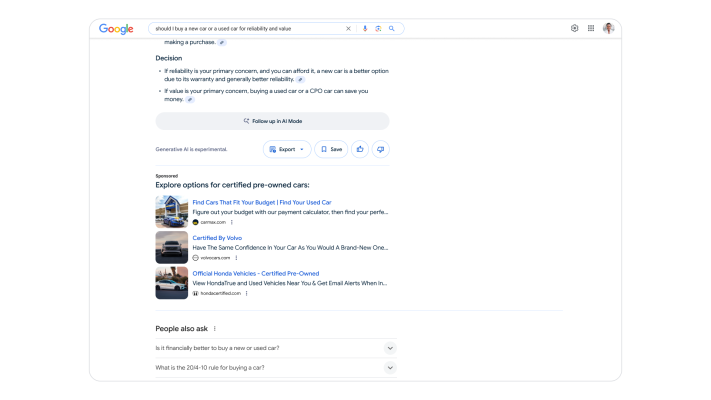
A search for ‘should I buy a new car or a used car for reliability and value’. At the end of the AI Overview: a Sponsored block with car ads. The line above the ads (‘Explore options for certified pre-owned cars’) was not written by the advertisers.
Exact and phrase match keywords ‘aren’t eligible for contextual matching on broader exploratory questions’. They do still qualify on searches with clear buying intent. Broad match, Shopping, Performance Max and AI Max get both kinds. AI Max is a Google setting that widens which searches your campaign matches.
Now my opinion. Being eligible for more searches is not the same as getting more customers. Someone asking why their pool is green is still far from buying.
To me, that’s no reason to switch match types. Not in Australia, New Zealand or Singapore, where you can test it. Not in Europe, where Google doesn’t list it yet.
I write my own ad text. Does Google decide what my ad looks like?
Partly. The ad is built from your own headlines, descriptions, images, prices and landing pages.
But in some placements Google adds ‘AI explainers’. That’s a short, separate text written by Gemini, Google’s AI model. Gemini bases it on the search, the AI answer and public sources, including your website.
You ‘can’t manually write, edit, approve, or opt out of them’.
So to me, wherever explainers run, your website is part of your ad copy. If it lists old prices, Gemini can pick those up.
Can I opt out?
Not separately from Search. You can’t target only AI Overviews or AI Mode, or switch them off on their own.
What you still control:
negative keywords (words you don’t want to show up for)
brand exclusions (keep your ads off searches for certain brands)
pinning (fixing a headline or description to one spot in your ad)
What does “in aggregate” reporting mean in practice?
As far as I can see, you can’t look at these results separately. They’re ‘included in aggregate’ in your normal reports. Google doesn’t literally say ‘no breakdown’, though.
To me, long, chatty search terms are a hint. But Google doesn’t mark which ones came from an AI answer.
How these ads count in the ‘top of page’ reports is unclear too.
What should I do now?
If you advertise in Australia, New Zealand or Singapore: your Search, Shopping and Performance Max campaigns are already eligible on English searches. I’d read your search terms report for long, question-style searches. Add negative keywords for the ones that will never buy.
If you advertise in Europe: I think nothing urgent.
Two things I’d do on both sides.
Check that your website is current. Prices, service area, opening hours, what you actually offer. It’s one of the sources Gemini uses.
If you run a webshop: I’d keep your Merchant Center feed clean. That’s the product list Google reads for your Shopping ads. It’s on Google’s list too, but it pays off with or without AI.
Google’s other ‘best practices’ point to its own automated tools. Broad match, AI Max, Performance Max and Smart Bidding (Google’s automated bidding). Also text customization and final URL expansion, where Google rewrites your ad text and picks landing pages for you.
To me it’s no surprise that they’re all Google products. I’d read that list as Google’s advice, not mine.